In my years of aesthetic practice, one of the most common complaints I have from patients is that they feel that their face is sagging. Most complain of jowls seen under the jawline making them look older. So they start consuming products to sort of enhance their collagen to improve the sagging skin but most products do not seem to work.
Before you can treat the problem, you need to understand what it is. As we age, our body undergoes a lot of changes in terms of anatomy and fat, muscle, or tissue redistribution. Here is a nice picture depicting the changes of ageing taken from The Journal of Facial Plastic Surgery Clinics of North America.

1. Thinning of hair and receding hairline.
2. Forehead rhytids and ptosis. ----> (Forehead lines and loss of volume)
3. Glabellar Rhytidosis. ------> ( Also know as frown lines)
4. Brow ptosis.
5. Temple rhytidosis and ptosis.
6. Upper lid redundancy and ptosis. -----------> (Lid droop)
7. Lateral canthal rhytidosis. -------------> (Crow's feet)
8. Nasal root rhytidosis. ----------------> (Bunny lines)
9. Lower lid redundancy and rhytidosis --------------> (Under eye wrinkles)
10. Lower lid fat pseudoherniation. ---------> (eye bags)
11. Malar bag formation. ---------> (eye bags)
12. Cheek rhytidosis.
13. Periauricular rhytidosis.
14. Nasal tip ptosis and dependency.
15. Cheek sagging and fat atrophy changes. ----------------> (face hollowness)
16. Deepening nasolabial crease ---------------> (laughing lines)
17. Facial rhytidosis and sagging. ---------------> (cheek wrinkles and sagging)
18. Perioral rhytidosis. --------------------------> (perioral wrinkles or smoker's line)
19. Upper lid flattening and lengthening.
20. Thinning and atrophy of the vermillion (red lip)
21. Chin pad ptosis and retraction.
22. Jowl formation ---------------------------> (jowls or face sagging)
23. Cervical rhytidosis ----------------------> (Neck wrinkles)
24. Submental fat accumulation -----------------> (double chin)
25. Platysmal banding
26 Rhytidosis and midneck hollowing
27. Submaxillary gland ptosis.
I like this diagram because it covers all the possible facial ageing signs on a persons face. Yes, it is also a very ugly picture. Most people may have only 5 or 6 on the list after a certain age, but ageing is not just chronological. It also depends on your sun exposure, your lifestyle, nutrition, genetics, etc.
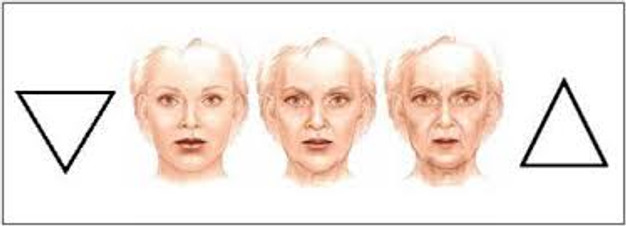
So what was once upside down triangle face that most people regard as youth, slowly, gravity starts pulling downwards until the triangle becomes bottom down.

This image shows a more colourful and easier diagram than the first of what happens as we age. Our eye sockets appear bigger due to reabsorption of the bone and the shifting of the fat pads to either due to prolapse or loss of volume. The prolapse seen around the eye also is related to the increase laxity of the surrounding ligaments. Bags form around the eyes develop from laxity of the tissue surrounding it. Lines form on the face from loss of volume and movements that form expressions of the face. Combined with thinned out, unhealthy skin, it can look worst in some people.
So basically, the phenomenon of sagging of the face is not as easy as taking strings and pulling it to make you look tighter. It involves a more comprehensive knowledge and practical approach to getting the best results that is suitable for you.
Usually, my approach would be to see what bother's my patient most. And from there, we decide, what is the likely cause i.e. loss of volume in the temples or malar fat pads, reduce skin elasticity due to exposures to sun, over wrinkling due to over expressions, or other reasons that contribute to the sag look that the patient is not happy with. By explaining the cause of sagging, then only can the doctor prescribe the best form of treatment to a patient and whether surgical intervention is more likely a better choice in the patient's best interest.
So is there a treatment for sagging?
The answer is, not a single treatment but more likely a series of combined treatment treating each and every problem located above. Honestly, looking at the above diagrams, most of us would have more than 1 issue. What is more important is to sit and discuss treatment options and costs and do a proper planning of how to achieve the best results.
I will continue in my next blog on what are the treatment options available to treat the sagging face.
For more questions or appointment enquiries please email to drmmclinic@gmail.com or msg us at 0123301585, or call 0321106608.


