Sunday, November 27, 2016

Post Raya Blues...... Its not all that bad.

It is the week after the Raya holidays and the kids are back to school. The adults have to get back to work despite Raya being a whole month of celebration. Yes, even though Eid arrived on the 7th of July, in Malaysia, Raya is celebrated till the end of Syawal with open houses, festivities and of course food and more food.

Today being the first day after the long Raya weekend, the streets of Kuala Lumpur still appear pretty much tranquil as most people would have taken an extra day off in case of the massive traffic entering back into the metropolitan city that may incur hours of jam. And of course, the finals of the Eurocup 2016 was airing at 3 am this morning with a miraculous win of Portugal over France with a score of 1-0 during extra time unexpected since their star player Ronaldo was taken off field for injury earlier on. For most Malaysian men, football is as loved as food, regardless of which continent it plays in, hence probably a quarter of the nation is at work bleary eyed from watching the game. C'est la vie.... Sorry France, you'll have to tie Spain some other year.


Courtesy of Star.com.my 

With a long week of holiday after a whole month of fasting, the most common complaint you would always hear about is how a person loses a few pounds during fasting and then regains back what is lost (or more) during the raya spree. Ah, yes, but how can you say no the the most delicious wondrous food that come out usually only once a year of celebrations. It is rare to see a Malaysian turn down rendang, ketupat, sate and all the different types of food every state has to offer, not to mention the multiple open houses that invites people to dine from morning till late night. Yes, we love our food, we love festivities, and we really love Raya.

But we are also the fattest nation in south-east Asia which was recently shown on recent statistics with a high prevalence of non-communicable diseases (NCD) like diabetes, hypertension, heart problems, spine issues etc. Hence, the post raya blues.

There are many studies linked to obesity and weight loss which gives us a good picture of how to reduce weight and what works and what doesn't. There are also so many products and fads in the market that promises weight loss and slimmer body. Whether they really work or not? Well, its hard to say since there is not much evidence collected on them. And when I say evidence, it does not mean testimonials. It means controlled comparison studies between product A and a placebo (placebos are usually just water or sugar tablets mimicking the original product but have zero effect on the person) blindly randomized and given to an x amount of people and observed over time. Testimonials are flawed because some people are paid to write positive testimonials on a product. We have so many websites offering ghost testimonials mimicking real life people that anyone can create testimonials and put them on their site.

On the lighter side, eating is culture in Malaysia. It would rude not too. But we can still keep off the extra pounds if we are mindful of what we eat. Here are a few tips to stave off the extra calories despite having to be guest to the many open houses.

1. Stay off the carbs as much as you can. 

Omitting rice, bread and other carbohydrates would definitely help to reduce the pounds gained. But still, the delicious food can be so enticing. Instead of completely omitting the carbs, try to portion the carbs to be smaller than usual. For example, maybe just a small portion of rice compared to the dishes or limit your ketupat lemang intake to just a fistful.


2. Watch out for additional sugars in the drinks.

Stay off the sodas and cordials if you can. Usually when I go to open houses, I would opt for plain water, sparkling water or coffee without sugar. All forms of canned drinks, soda, gas and fizzies are a complete no - no on my list. Cordials are minimally welcomed because usually they have been diluted in a lot of water. Fresh juices are acceptable but you barely get those in open houses. Teh tarik and nescafe tarik contains a lot of sugar from the evaporated milk used (approximately 182 kcal calories per cup). 

3. Kuih Raya are sugar culprits.

What is raya without kuih raya? We have a tendency to stock on these cookies during festivities. The problem is, eating these biscuits can be quite addictive and we tend to lose track of how many we take. Most of these cookies are sugar laden, margerine or butter laden, well you get the picture. They may look innocently small but 1 hari raya cookie can easily give you between 53-110 kcals of calories. Imagine taking 10?


4. Drink More Plain Fluids

Malaysia is a hot and humid country and Raya usually falls in the middle of the year where it is super hot. Eating all the salty and sweet foods also leads to more dehydration and thus we need to rehydrate constantly with water. This also helps with our digestive system and bowels to avoid constipation. The more you eat, the more you need to drink to get it out of your system as fast as possible,

5. Local fruit are sugar menaces. Take in moderation.

We are always encouraged to take fruits in our diets and told to increase servings. However, our local fruits tend to have a higher sugar content due to the tropical nature of the fruits. Durian is a common favourite among Malaysians. It is tasty but 1 seed is roughly 50 kcal calories. Imagine eating a whole fruit? It can come close to 1200 kcals for a fruit. For those durian lovers, limiting to 2-3 seeds per day is actually the best way to go. Besides, you have other things to eat which are equally heavy in calories. Moderation is always the key.


 Courtesy of www.huffingtonpost.com

Well, of course if all else fails, you can always come in for a proper consultation on weight loss management and regimes to help get back that shape you wanted. For a limited time only we are offering 30% off our HCG diet programs and Mesotherapy spot treatment courses. Offer valid for the whole month of July only so book your treatments now.

Contact us at drmmclinic@gmail.com or send us a txt to +60129660852 for more information or to grab this deal.

Pearl Fair Complexion with Lucent

I'm reposting this blog from my other blog since some of my subscribers complained saying that I don't write anymore. I do. But in a different blog. So to be fair to my readers, I will be pasting the blogs from the other site to here so that you won't miss them.

Practising medical aesthetics for the past 8 years have made me realize how much the society looks for alternatives for smooth fair and glowing skin. Personally, I've never really been into the super fair look, I love my olive tan skin.  However, part of being a good doctor is understanding patients wants and needs. Being as fair as snow white is one of them.


XL

So why are Asians especially in the East obsessed with being fair? Although many would think that it was due to the caucasian influence of Hollywood and blonde actresses, its actually more of social stature. In the past, the tanner you are shows that you are of the peasant group working int he fields or hard labour. Fairer people tend to be more indoors, hence believed to be of higher stature. During the Han dynasty in China, a beautiful woman is defined by pale white pearl-like skin usually seen in the palace concubines. In today's world, despite the lack of social class differentiation by occupation, there is still a strong sense of social class interpretation by just looking at a person's skin. This is why whitening products and make up is so popular in this part of the world.

I have had my share of experience trying out whitening products in the market from IV injections to creams to even oral supplements. To a certain extent, each and every product does have its pros. Products that fail to do much usually, I would feedback to the maker, because I am really not into writing bad reviews. My prophet once said, if you have nothing good to say, say nothing.

Today, I am going to tell about a new whitening supplement int he market. To be honest, I was asked to sample this product since last year, and it gave really good results, but they were having delays with packaging and getting the product in. It is a whitening tablet called Lucent. If you have read my previous blog reviews, there is a similar product called Crystal Tomato which I also liked.

Lucent is produced by another company with similar ingredients and an added touch. Each box comes in 60 tablets of 400mg pills containing lutein extracts from tomatoes, vitamin c, glutathione and coenzyme q10. It promises more luminant skin within a few weeks consuming.

L

So what's the verdict? I took 2 boxes of Lucent.Initially I took 1 tablet in the morning and 1 at night both on empty stomach. The pills were the size of a panadol actifast, and it was easy to swallow. It was not bitter to taste. During this period I stopped every other supplement I was on including my vitamins. My assistant noticed my skin looking brighter after 7 days of taking 2 tablets daily. After the second week, I also noticed some of my pigmentation have lightened and my skin tone looked more even. I became a bit more adventurous and took 2 tablets in the morning and 2 at night and within 3 days, my skin became a tone lighter. I continued for a week more then went back to 1 tablet morning and 1 tablet night time. After the 1st 90 tablets (6 weeks), I decided to put myself on maintenance, i.e. 1 tablet on the morning for the remaining 30. The fairness continued until I finished and subsequently for the next 2 weeks, when I started to notice the effects diminishing. But for what it's worth even on only 2 boxes I had a continuous brightening of almost 4 months.

According to my suppliers, the recommendation is to take 2 boxes 2 times daily (2 months) and then maintain a tablet a day for the next 4 months (which technically is only another 2 boxes). You can also opt to continue the supplement to maintain your skin fairness and it is also a good oral sunblock.

Benefits:
1. Skin brightening and fairness as early as 7 days.
2. Acts as a oral sunblock to protect from UV rays.
3. Lightens existing pigmentation as early as 4 weeks.
4. You can take more to hasten effects without any major side effects.
5. During maintenance, 1 box will last you 2 months so it can be more economical.
6. Avoids the hassle of frequent IV injections that can cause pain, or if not careful vein      
    injuries and hardening.
7. Long lasting effects even after stopping the supplement.
8. It is a supplement not a drug. So far, there is no adverse reaction to the product to any of
    the vital organs.
9. It supplements other whitening treatments undergone, thus giving a more lasting effect.
10. Perhaps a complete must have for PIH (post-inflammatory hyperpigmentation) prone
     skin to have in their daily routine to avoid PIH and lessen the duration of previous PIH
     scars. In fact, it reduces post procedural PIH incidences of patients undergoing other      
     aesthetic procedures like chemical peeling and lasers.

Cons:
1. You need to be consistent to take the tablets to have the results.
2. You will only lighten to maybe 2 tones than your fairest part of your body (non-sun
    exposed area)
3. You will need to keep the supplement in the fridge, since the high vitamin C content makes
   it oxidize easier and changes the pill colour to yellow. However, even if the pills change
   colour the efficacy of the results remain the same.

So how much is this superb whitening supplement? Market price is between RM 550 - RM 650 for a box of 60 tablets inclusive of GST. At the moment, as a sneak preview, we are selling this awesome product for RM 450 a box for the month of December only. Take a whole course of 4 boxes and get each box for RM 400 only. Yes, GST included. Limited time only till 31st December. 

For more information or to book appointments please email us at drmmclinic@gmail.com or text / whatsapp us at +60129660852.

The Sagging Face .......... Part 2 (Treatment Options)

Well, that was a long hiccup from my last entry. My apologies to my fellow readers. Sometimes it is hard to find that quiet time to let the words flow and produce good quality writing. Well, anyway, as I promised before. Let's continue our discussions on the sagging face.


So now we know that there are many factors causing the face to appear to sag, from anatomical differences i.e. weight loss or gain or alternating of the two, skin texture loss or just the very process of ageing which leads to bone resorption especially around the orbits and the maxilla. Let's discuss the options of treatment. Bear in mind, the options are not sequenced according to the most effective method. Based on the patient, sometimes 1 or more modalities are required or multiple sessions.

1. Botulinum Toxin A facelift injections.

I remembered when I first started to  join the Medical Aesthetics field, my seniors were in the hype of the 'Botox-lift' which uses diluted BTA intradermal meso-injection techniques at certain areas of the face and neck to produce a slimmer tighter look and feel. The jawline tightening was dubbed the Nefertiti lift and was published in one of the medical journals. It was a quick and simple way of getting a tighter look by only spending 15 minutes in the office. Although the results were quite good, unfortunately, it only lasts between 1-3 months post injection and it does not tackle volume loss issues. Complications may include asymmetry of the face especially if there is a marked power difference from one side of the face to the other, or if the injections were too deep and inoculated into the underlying muscle. Per procedure will cost around RM 1000 - 2500, depending on the units used and the patient would have to come back to the clinic every 2-3 months to sustain the results. Some doctors are still doing this technique. Personally, I only do this upon patient's request.

2. Dermal Fillers - Hyaluronic Acids (HA)

Besides volume filling, dermal fillers can also be used for tightening. Nowadays with the newer HA fillers that gives better volume than the previous ones, we can do point injections to lift up the overlying tissues (muscle,skin, etc) to give a more tighter look. The injection sites usually involves the temples and the cheeks, with additional fillers used to fill up volume deficiency. However, you will need at least 2 syringes of a good volume filler (3-4 of the less dense fillers) to get the best effect. The good news is that it will last at least 12 months, and some of these HA fillers last up to 24 months or more. For non-HA fillers, Radiesse also has a tightening protocol using similar point techniques with an additional vector technique aimed to sharpen the jawline and bring up jowls. It requires at least 2 syringes on the first sitting, with possibly a follow-up syringe after 3 months for it to last 6-15 months. However, for both these types of fillers would require a fairly good texture of the skin in order to get the result. Other things consider is how good is your doctor at doing the procedure and the risks of bruising and lumpiness is always there. Cost wise, you will be spending around RM 5,000 (since its definitely going to be more than 1 filler) but if done well, you an have a good satisfactory result lasting 9-18 months on average.


3. Poly-L-Lactic Acid Fillers

These are a different type of filler that stimulates your own collagen formation by means of injecting PLLA into the face. There are 2 common ones in Malaysia which is Sculptura and Aesthefill. The procedure requires 3 sittings, once every 1-2 months. Per sitting 1-2 vials of the product is injected into the face. The effects of the procedure can be seen as early as 2 weeks but usually 4 weeks you can start appreciating difference. The only problem is the downtime. It requires multiple injections to the skin which may lead to bruising. Usually the bruising subsides in a few days to a week, but some patients can bruise up to 2 weeks. Another problem is that it may cause some fibrosis under the skin thus making future filler injections pretty difficult especially if the injector is less experienced. Despite the downtime and the bruising, I must say, I am pretty impressed with the results. I had a good friend who decided to go on an extreme diet and exercise regime which caused him to have very severe sagging and a turkey neck. However, after 2 months of the first session, he improved so much that he looked younger than when I first met him a couple years back. Its been almost 2 years, and he still looked great. He just redid his face recently.  For this procedure, patients are required to take a whole course since you need to come back at least 2-3 times. The solution requires preparation, so you will really need to schedule the appointment beforehand. The price of 1 vial is RM 2500. Usually 3 sessions (4-5vials) would be charged at RM 10,000 for the package.

3. Radiofrequency Devices. (RF Devices)

This is perhaps one of the oldest techniques used for skin tightening but is still considered the best solution for skin tightening. However, bear in mid that there are different spectrums of machines used. The ones used in beauty salons are beautician grade, thus the power and intensity of the machine is much less. Some doctors buy these machines because they are cheaper (perhaps 10x cheaper) than the medical grade ones. Medical grade machines have to undergo series of clinical testing and approvals before sold to the market. It also requires proper training to avoid complications and deliver the best results. The medical grade machines in the market are like Thermage, Accent and Pelleve. Actually, there are so many RF devices in the market. Depending on which machine you are using treatment can be as low as RM 300 per session on the lower end of the spectrum to a whooping RM 12K per treatment with Thermage. Most RF machines except Thermage require repetitive treatments. The medical grade devices uses recommend 4x minimum. The beautician grade ones, usually 8-10x. The difference between medical grade and beautician grade device is that the medical grade devices are guaranteed to deliver the 40mJ of energy required to heat up the dermal tissue between 42-60 degrees. Thus, the results can be reproducible and repeat with more accuracy. However, the other factor in the delivery of treatment is the skill of the person handling the machine. A well trained user will deliver a better result, despite the machine being the same. 

4. Intense Pulse Light (IPL)

IPL is one of the oldest light based devices used in aesthetics. Using filters to control wavelengths of light enables the user to target specific needs to the patients face. Similar to the RF devices, there are medial grade and beautician grade IPLs, which differs in terms of intensity and function. The usual wavelength filter used for skin tightening is between 500-1200nm and has shown great results in reducing skin laxity, wrinkles and also telangiectasia. Treatment price ranges from RM 800  - RM 1500 , depending on the type of IPL and area used. However, being a much older technology requires more skill on the doctors side to handle the device and the treatment. Complications are more common in darker skin types and are not limited to blistering, burns and peeling. Usually skin tightening procedures are not very painful compared to hair removal and is tolerable without anaesthesia. This treatment requires repetition to reach the best results, usually 4-10x depending on the type of IPL used. 


XL
5. Ultrasound Devices

The latest hype on skin tightening devices would be the ultrasound devices or also known as HIFU devices (High Intensity Focused Ultrasound). The most famous perhaps is the Ultherapy device that has been competing with Thermage since it first came into the market in 2009. Nowadays, other companies have also started to produce their own HIFU devices for skin tightening. My experience on Ultherapy was during the initial phase of its launch. The treatments were painful, but according to the latest protocols, the intensities have been reduced and still produced similar results. Tightening results were good, but may need annual repetition to maintain. What I love is that they have new FDA clearance for other things like neck tightening etc. What I don't love is the cost per treatment ranges between RM 12-18K  and that the device costs a bomb. 

6. LED Devices.

Some believe that LED devices give tightening effects to the skin. Although it is more for skin rejuvenation as a whole, it does to a certain extent help to tighten the skin. The wavelength used is the 633nm red light that helps with rejuvenation. The only problem is that the tightening effect is overall and not targeted, so although it may work, it will take a longer time. Treatment prices range between RM 300 - RM 800 per session depending on the type of LED device.

7. LASER Devices

Most LASER devices are designed for rejuvenation or ablation and as a side result, some skin tightening are observed. However, there are LASERs that can use for skin tightening. ND YAG long pulse LASERs have been seen to give a good lift for sagging skin. It can be pretty uncomfortable and repetitive treatments are required. Treatment costs between RM 800 - RM 1800 depending on area and machine used.

8. Platelet Rich Plasma Procedures (PRP)

PRP treatments made a huge hype when Kim Kardashian posted on her social media about getting it done. Obviously she had more than PRP done on herself, but her stunt put PRP as one of the medical aesthetic treatments available in the market. Although PRP does help with rejuvenation, it only gives minimal tightening effect immediately. In the long run, maybe with volume increase and skin thickness increase, it will appear tighter but it would not be working specifically for the jowls. Treatment costs anywhere between RM 1600 - RM 5000 depending on which system they use and which method they inject it with. If its too cheap, be wary, it could be under treatment or done by an unexperienced doctor and you may not get the results you want. 

9. Threads

Threads use to be only the plastic surgeons territory for lifts, but now less invasive threads are available giving you an in-office procedure. There are 2 types of threads used in clinics which are the suspension threads and the PDO threads. Suspension threads like Silhoutte Soft suspends in the fat layer of the face giving a temporary lift immediately lasting anywhere from 6 months to up to 2 years. The main determinant will be the amount of threads used and the technique. Plus whether any anchoring to the SMAS was done. It works on lax skin making it tighter. However, usually 20% of the tightening effect will reduce after 2 months when the swelling from the initial procedure completely subsides hence why sometimes, the doctor tends to pull a lot tighter in the beginning. It would be a good solution to jowls except the cost of the treatment is around RM 4000 - RM 8000 per sitting depending on number of threads used. Some threads requiring anchoring can cost up to RM 20,000 per sitting, which makes you want to consider visiting the plastic surgeon instead. The other threads available are the PDO threads. Now the Koreans have modified them to allow longer lasting effects compared to the first generation of PDOs. Although we can use PDOs for tightening via collagen stimulation, it takes a few sessions (3-5 sessions) over a period of a couple months to get a really good result. The cost is cheaper than suspension threads, roughly around RM 2500- RM 5000 per sitting depending of amount and types of PDO used. Sometimes, doctors would used a combination of both suspension and PDO threads for a better result and this can cost a whopping RM 7000 - RM 12000 per sitting. The only problem with threads is the downtime. If you are lucky you may not bruise, but most of the time it takes between 5-14 days for the bruising and swelling to subside.


XL
10. Mesotherapy

Mesotherapy is the practice of giving micro injections to the face. For face tightening, certain mesotherapy cocktails can be used to improve skin tightening. However, it may be temporary lasting only 2-4 weeks and they maybe risk of pain and bruising. You also require to do multiple sessions (5-10 sessions on average) to get a good result. Some clinic use mesorollers, mesostamps or mesoguns to aid the process.  The cost can vary between RM 250-RM 1200 per session depending on the cocktail and the method used. 

11. Tightening Creams 

I included this in as now a lot of clinics sell products that promises instant tightening of the skin. There are a few scientifically proven substances that can help with skin tightening. One of the most mentioned are the DMAEs (di-methyl-amino-ethanol) which has clinically proven to tighten up the skin. Another common component would be the non-cross link hyaluronic acids which claim to help with hydration and skin tightening too. Personally, i think the molecules maybe too big to be absorbed well. Plus it is aquaphilic, and our skin is water proof. Another amino compound that has made highlights is the 8-hexapeptide complex that helps to reduce wrinkles for 8-12 hours dubbed as the alternative to botulinum toxin. (Honestly, BTA works faster and better). Other active ingredients include retinoids (Vitamin A derivatives), salycilic acid, ATP, Coenzyme Q-10, and other peptides and cytokines. Epidermal Growth Factors (EGF) also plays a role although it is more of rejuvenation of the skin compared to just tightening.


XL

Regardless of whatever treatment modality that appeals to you, a good consultation with your aesthetic doctor is always important to get a better idea of which treatment or treatment combinations suit you best. It is always good to preplan the procedure so that you can afford the social downtime if required.

For more question or to book an appointment, do contact us at drmmclinic@gmail.com or call / text /whatsapp to 0129660852 .

Monday, April 18, 2016

The sagging face....... PART 1 ( The Why?)

In my years of aesthetic practice, one of the most common complaints I have from patients is that they feel that their face is sagging. Most complain of jowls seen under the jawline making them look older. So they start consuming products to sort of enhance their collagen to improve the sagging skin but most products do not seem to work.

Before you can treat the problem, you need to understand what it is. As we age, our body undergoes a lot of changes in terms of anatomy and fat, muscle, or tissue redistribution. Here is a nice picture depicting the changes of ageing taken from The Journal of Facial Plastic Surgery Clinics of North America.


1. Thinning of hair and receding hairline.
2. Forehead rhytids and ptosis.   ----> (Forehead lines and loss of volume)
3. Glabellar Rhytidosis.    ------>  ( Also know as frown lines)
4. Brow ptosis.
5. Temple rhytidosis and ptosis.
6. Upper lid redundancy and ptosis.   -----------> (Lid droop)
7. Lateral canthal rhytidosis.    -------------> (Crow's feet)
8. Nasal root rhytidosis.       ----------------> (Bunny lines)
9. Lower lid redundancy and rhytidosis    --------------> (Under eye wrinkles)
10. Lower lid fat pseudoherniation.     ---------> (eye bags)
11. Malar bag formation.                       ---------> (eye bags)
12. Cheek rhytidosis.
13. Periauricular rhytidosis.                  
14. Nasal tip ptosis and dependency.
15. Cheek sagging and fat atrophy changes.      ----------------> (face hollowness)
16. Deepening nasolabial crease                     ---------------> (laughing lines)
17. Facial rhytidosis and sagging.                  ---------------> (cheek wrinkles and sagging)
18. Perioral rhytidosis.  --------------------------> (perioral wrinkles or smoker's line)
19. Upper lid flattening and lengthening.
20. Thinning and atrophy of the vermillion (red lip)
21. Chin pad ptosis and retraction.
22. Jowl formation  ---------------------------> (jowls or face sagging)
23. Cervical rhytidosis    ----------------------> (Neck wrinkles)
24. Submental fat accumulation   ----------------->  (double chin)
25. Platysmal banding
26 Rhytidosis and midneck hollowing
27. Submaxillary gland ptosis.

I like this diagram because it covers all the possible facial ageing signs on a persons face. Yes, it is also a very ugly picture. Most people may have only 5 or 6 on the list after a certain age, but ageing is not just chronological. It also depends on your sun exposure, your lifestyle, nutrition, genetics, etc. 


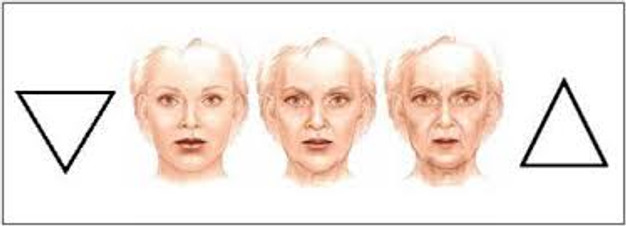
So what was once upside down triangle face that most people regard as youth, slowly, gravity starts pulling downwards until the triangle becomes bottom down. 


This image shows a more colourful and easier diagram than the first of what happens as we age. Our eye sockets appear bigger due to reabsorption of the bone and the shifting of the fat pads to either due to prolapse or loss of volume. The prolapse seen around the eye also is related to the increase laxity of the surrounding ligaments. Bags form around the eyes develop from laxity of the tissue surrounding it. Lines form on the face from loss of volume and movements that form expressions of the face. Combined with thinned out, unhealthy skin, it can look worst in some people.

So basically, the phenomenon of sagging of the face is not as easy as taking strings and pulling it to make you look tighter. It involves a more comprehensive knowledge and practical approach to getting the best results that is suitable for you.

Usually, my approach would be to see what bother's my patient most. And from there, we decide, what is the likely cause i.e. loss of volume in the temples or malar fat pads, reduce skin elasticity due to exposures to sun, over wrinkling due to over expressions, or other reasons that contribute to the sag look that the patient is not happy with. By explaining the cause of sagging, then only can the doctor prescribe the best form of treatment to a patient and whether surgical intervention is more likely a better choice in the patient's best interest.

So is there a treatment for sagging? 

The answer is, not a single treatment but more likely a series of combined treatment treating each and every problem located above. Honestly, looking at the above diagrams, most of us would have more than 1 issue. What is more important is to sit and discuss treatment options and costs and do a proper planning of how to achieve the best results.

I will continue in my next blog on what are the treatment options available to treat the sagging face.


For more questions or appointment enquiries please email to drmmclinic@gmail.com or msg us at 0123301585, or call 0321106608.

Monday, April 11, 2016

Sleep .......... Are we getting enough?


Travelling across time zones really messed up my normal sleeping pattern. But, come to think of it, I think I sleep better now compared to before, it is just that the timing is a bit off. Like sleeping early and waking up at 5, then falling asleep again at 8 and waking up at 10. But in terms of hours of sleep and quality of sleep, I think it has improved a lot since my last trip. The main focus is quality of sleep and getting that crucial 7.5 hours daily.

I was a victim of poor sleep hygiene like most workaholic city dwellers are. Plus, the intensity and demands of work previously when I was in the hospital were certainly not feasible. Imagine working from 7am to 5pm the next day. Yes, my houseman days in GHKL were super, the time we spent in the hospital was phenomenal. But we loved our job and our patients so much, most didn't even complain. We took it as part of the training to make us become more apt and precise in our decisions despite being under physical and mental duress. 

However, despite not being on-call anymore for the past couple of years, I found that I had a hard time switching off at night, and I wake up considerably easy. Turning off my phone was becoming an anxiety to me, and my late onset insomnia did not improve. I would wake up in the middle of the night and lie in my bed staring at the ceiling for hours unable to go back to sleep, only to doze off a few minutes before my alarm clock went off. It was draining my energy and causing my focus and concentration to wane. To some extent, I was getting a bit more depresses and irritable.

Many of us do not realise how sleep deprivation affects the body. Some people come to me and brag about sleeping for only 3-4 hours a day and able to function normally. (Are you sure?) Some people think its normal but many studies on human behaviour and sleep have shown that chronically sleeping less than 6 hours a day is detrimental not only to your physical health, but affects you mentally, emotionally and socially. 

So why is it important to get that good night sleep?

1) It affects your mood. 
    Lack of sleep causes irritability, lack of motivation, anxiety and depression.

2) Lack of Sleep makes people more prone to accidents.
    It is one of the leading cause of automobile accidents and occupational hazards.

3) It affects your intelligence and memory.
    Lack of sleep makes you forget things, and reduces your mental alertness to up to 32% if
    sleep deprived to less than 6 hours a day of sleep. It stunts creativity. It affects
    concentration, understanding, rationale thinking and problem solving processes.

4) It affects your sex drive.
    Studies have shown that lack of sleep reduces libido in both man and women. In fact, some studies also shows low levels of testosterone secretion in men deprived of sleep.
     
5) Lack of sleep ages your skin faster.
    Apparently beauty sleeps are not just an excuse to sleep early. People who are deprived of
   sleep for a couple of days have sallow skin and puffy eyes. Chronic sleep loss affects the skin worst    causing dark eye circles, formation of fine wrinkles and dull skin. Lack of sleep causes increase in      cortisol hormone levels that is also involved in the breaking down of collagen. 

6) Losing Sleep can cause you to gain weight.
  Most people believe that sleeping can cause you to be fat but actually the reverse is true.                Depriving yourself of sleep makes you gain more weight. A few studies conducted showed    that  people who lack sleep tend to consume more especially in the awkward hours thus  exceeding the  daily caloric requirements leading to weight gain. This was because lack of    sleep reduces the  secretion of leptin (your satiety hormone) and increases the production of  ghrelin (hunger hormone)  making people who sleep less than 6 hours a day experiencing  more hunger. The worst part is, lack  of sleep makes you crave for high fat and high sugary  foods. I think most people can relate to this.

7) Lack of sleep increases mortality risk.
  If you want to live longer, you should sleep more. As a hyperactive teenager, my dad use to  tell me  this. He wasn't too far from the truth. Studies have linked lack of sleep (i.e. sleeping  less than 6    hours a day) to be associated with increased risk of death to twice the risk  especially cardiovascular.

8) Sleep deprivation is associated to a lot of serious medical problems.
 There are many medical problems related to chronic sleep deprivation:
 a) Hypertension and high blood pressure
 b) Heart disease
 c) Heart Failure
 d) Irregular heart beats - arrythmias
 e) Stroke
 f) Obesity
 g) Diabetes
 h) Depression & other mood disorders
 i) Attention Deficit Disorder

9) It affects relationships.
  If your partner has sleeping issues and is deprived of sleep chronically, long term it will be a challenge for the you to cope especially when he or she has reduce mental performance,  less energy, low mood, lacking of motivation, low libido etc. In fact, he or she may start  influencing you to have reduced sleeping hours leading to your own problems. Your partner's sleep disturbances may disrupt your own sleep too.


How much sleep should we have in 24 hours?

Most studies agree that an adult between 18-64 years old should try to get 7-9 hours of quality sleep everyday. Here is a beautiful chart courtesy of the National Sleep Foundation on different age groups and sleep recommendations.


So, if you are sleeping less than the recommended hours, you better start deciding on trying to make more time for sleep. Some people have difficulty in falling to sleep or staying asleep. Others feel like they can sleep but does not have enough good deep sleep and keep waking up. Some people have sleep apnoea issues that causes them to have bad quality of sleep. Some people grind their teeth at night or wake up with muscle cramps. Although it may seem to be common, you should take to your health provider about any sleep disturbances you are experiencing because there are treatments available.

For more information or if you have any questions on sleep, please email to drmmclinic@gmail.com. 


Monday, March 21, 2016

Its All About the C's

Its the start of spring and we are entering the second quarter of the year. Busy schedules and a lot of hard work for most of us due to the current economic slow down that is happening worldwide. In the hustle and bustle of keeping up with the rat race, it is really important to keep our health intact to meet up with our expectations. So for the next couple of weeks, I will be explaining about vitamins, minerals and supplements required for the body to function better. 


Let's start with the big C. Vitamin C is a very important nutrient for our body. Humans are the only mammals in the world that does not produce their own vitamin C. Other animals produce C's internally and it plays a major role in their immune system and survival. Because of this, we need to consume vitamin C's on a regular basis to keep our stores up.

In humans, the benefits of vitamin C has been established more and more. It is involved in the formation of certain proteins to make skin, bones, cartilage and blood vessels. It is also useful in wound healing and formation of scar tissue, repair and maintenance of bones, cartilage and teeth, and it also aids iron absorption. 

It also plays a strong role in aiding the immune system and helps alleviate colds, flus and otehr viral illnesses. Historically, it was used to avoid scurvy but nowadays, this problem is relatively rare due to reduced long sea travels. It is also used to maintain gum health, treatment of acne, treatment of bronchitis, H. pylori bacter related stomach ulcers, control of HIV, treat tuberculosis, dysentry, skin infections and help in curing infections of the bladder and prostate.

Recent studies also shown the benefits of Vitamin C in relation to brain functions. It helps reduce depression, Alzheimer's disease, reduce physical and mental stress, improve concentration, improve ADHD and reduce fatigue. It has also shown in a study recently that it reduces heart rate during exercise and reduces the perception of fatigue and exertion. 

Latest studies also show that it aids in heart disease and diabetes by improving endothelial functions and reducing inflammation thus improving the outcome. However, you will need to take more than 500mg daily in order to see the benefits. With improved endothelial functions, there is a reduced risk of artherosclerotic disease which is involved in stroke and heart disease. 

Other benefits of Vitamin include improves glaucoma, prevent cataracts, prevent gall bladder disease, relieves constipation, improves dental caries, improves Lyme disease, helps with heat stroke, hay fever, asthma, cyctic fibrosis, infertility, chronic fatigue syndrome, autism, collagen disorders, arthritis and bursitis, back pain and disc swellings and improves osteoporosis.

High doses of vitamin c has also been used in alternative cancer treatments and as adjuncts to chemotherapy to reduce chemotoxic effects and has shown to improve patient outcomes. It is also an anti-aging supplement that helps reduce signs on aging, whether applied topically, consumed or given IV.

The next popular question that I normally get is how to take the vitamin. Well, for skin problems, the best is to apply topically. If you can get a 'medical grade' vitamin C more than 20% concentration it would definitely benefit your skin by reducing wrinkles after 6 weeks of diligient bidaily application of serum. If you notice I purposely highlighted medical grade, because a lot of cosmetic skin care claim to have more than 20% vitamin C inside their products but in actual fact, when you test them most don't even hit 10%. Sometimes, they put 20% concentration prior to manufacturing and after processing, the vitamin C being a water soluble vitamin, the percentage reduces. If you want to try a good medical grade Vitamin C serum, we do carry a few brands.

The next easiest method is to consume orally. However, most people do not realize that the gut can only absorb 600mg of Vitamin C per 4-6 hours and this also depends on how good your digestive system is. Most Malaysians have really bad digestive system due to diets high in fats and carbohydrate and lack of fiber. We also have a lot of irritable bowel syndromes and leaky gut syndromes which causes poor absorption in the gut. Now with our hair profiler system, we can screen for leaky gut syndrome and improve your gut health with just a simple test. The other issue with concuming orally is the form of vitamin C that you are consuming. Some believe L-ascorbate is the best form to take, the clinical data on it is scarce. And at the end of the day, how much vitamin C can the body actually absorb in a day? Maybe 2 grams. However, really high doses of vitamin C taken orally can cause nausea, diarhoea and abdominal discomfort.

Some medical practitioners advocate intravenous vitamin C in high doses for immune curve shifting. This is to avoid gut wastage of the C's and deliver accurate high doses. The idea has been used for many years in treating people with cancer and severe immune problems and now some are advocating as an anti-aging regime. Personally, I did try 10gms of vitamin C over 30 minutes with a combination of glutathione 600mg, ALA and B Complexes. The infusion was a little bit uncomfortable despite being diluted with normal saline, and I felt stiff in the arm during the infusion process. Immediate effect for me was actually lethargy but I noticed improvements in my skin tone, pigmentation and feel. Immune wise, I guess I improved, because my sinuses improved without needing antibiotics. However, one off therapy wouldn't be sufficient and usually you will need a course to achieve a good concentration. Being water soluble, the vitamin gets excreted out by 3-7 days. However, the high dose concentration for a few hours is what gives the body that extra boost to jumpstart the immune system.

Regardless, if you are unsure or planning to start high dose vitamin C regimes, please consult a medical practitioner that is well verse in the indications, contra indications and side effects. There are some contra indications to the use of high dose vitamin C that you will need to discuss with your doctor to ensure it is safe for you.

For more information please email us at drmmclinic@gmail.com or call us at 03-21106608 or send a msg to 0123301585.


Wednesday, February 24, 2016

What you should know about fillers......

It has been a while since I wrote anything about fillers. However, recently during one of my socializing events I was faced with a lot of questions regarding fillers and botox. There was a great confusion between the two, still, despite both being very separate and totally different entities in terms of chemical compound and function.


1. So what Are Fillers?

Fillers are substances you use to fill up areas of your face or body which has underwent volume depletion and is also used to reduce static lines. It can be from any substance like silicone gel, collagen, hyaluronic acid, calcium hydroxypatite, PLLA, PMMA or even biological fillers like heated PRP or fats. The most commonly used in a medical aesthetic practice are the hyaluronic acid fillers which are non-permanent and lasts between 6 months all the way to 24 months depending on how the cross-linking and molecular weight of the filler.

2. Are All Fillers the Same?

Definitely not. Different chemicals form different fillers. Therefore it is really important to know what type of fillers were used on your face. Some may not be reversible. Always ask your doctor what he or she is using. Not only it is good for you to know, but it also helps the subsequent treatments if you require any.

3. If I do not like the filler effect can I remove or change it?

Only Hyaluronic acid fillers can be diluted with hyaluronidase. The other fillers are almost impossible to remove without any surgical intervention. So make sure you know what you are putting under your skin.

4. How much does fillers usually cost?

Fillers are usually quoted by per syringe of usage. An original high-end filler product can cost anywhere from RM 1600-RM 3600 per syringe. Some other lesser brands cost between RM 800- RM 1500 per syringe depending on where it was made and specifications. Anything sold cheaper than that would either be non-original products or maybe expired fillers? Or sometimes the doctor is not so experienced that they give cheaper pricing to practice. Honestly, who would charge super cheap for well trained hands? The training itself requires a lot of money.

5. Does it hurt?

Honestly, any procedure involving needles would hurt to some extent, but depending on the type of filler, some fillers hurt more than the rest. It also depends on whether there is any lidocaine inside the filler that will reduce pain tremendously. Local numbing like creams can be used although it doesn't really make much difference physically (maybe psychologically) and local infusion of lidocaine does help to reduce pain effectively although very specific filler work would be impaired as there is already tissue distortion. You can discuss with your doctor pain management techniques that can make your experience much tolerable. So apparently, you do not need to suffer too much pain for beauty. If, in event the doctor injects and suddenly there is severe pain, please speak up and tell him or her. Severe pain might mean that an artery is being hit, or other crucial vessels, or even allergy to the filler.


6. What can fillers do for me?

I always tell my patients, imagine fillers are like cement or plasticine. You can create volume which is not there like nose, cheeks or chin. You can redefine areas of your face and make contours, you can even smoothen deep lines. You can redefine your lips to make it more prominent or replenish the younger look. You can put it at your tear trough areas and reduce the sagged eye look and make you look fresher. You can reduce appearance of scars and improve photo angles (if your doctor is really really good). 

7. If I use a good filler, will it guarantee a good effect on me?

A good filler is always recommended to get the best effect. However, the other more important component is the doctor. How good is he/she at creating the effect you want? A lot of people think that filler injecting is just about injecting, but actually it is not. The best filler injectors in the world can put fillers on to a persons face and make him or her look more attractive but at the same time make it look as natural as possible that to most people, it doesn't look like any fillers were done. (Until you compare the before picture).

8. So say that I am interested, how sure can I be safe to do the procedure?

For newbies and virgins, I usually tell them to stick to hyaluronic acid fillers for any work because at least if you do not like it, we can dissolve it or wait for the effect to go off. The other most important thing is how well the doctor is trained because not all doctors are trained to do fillers. In my years of training other doctors practical filler techniques, I notice that even the way a doctor holds the syringe is enough to tell me how experienced they are. It is not the same as blood taking or other hospital procedures. Furthermore, to train the hand to be steady enough to evacuate the product from the syringe equally is quite a task if you are not use to it. To create beautiful natural looking work requires an additional artistic eye to detail which not all doctors have. Furthermore, if any problems from the procedure were to arise, a trained aesthetic physician would know what to do. Beautician filler injectors are the worst because for 1, you do not know what are they really using (they have no access to original medical grade products), 2. They are not trained to understand surgical anatomy or deal with complications, 3rd, if you allow a beautician to inject you, you cannot take any action on to them if the job is not done well, as they are not regulated by law, and you would have committed the first offence of going to a non-professional. Furthermore, there is a science and mathematical equation when we put fillers on to a person's face that is being taught in our training so that you remain looking like a human (and not some weird alien from star trek or some other sci-fi movie).

If you have any more questions on fillers, feel free to contact us at drmmclinic@gmail.com or 03-21106608.